Designing the system behind the screens for a bank's revenue engine
A governance-aware product and pricing ecosystem handling lifecycle orchestration, operational validation, dependency intelligence, and future-dated financial configurations.
Platform Evolution
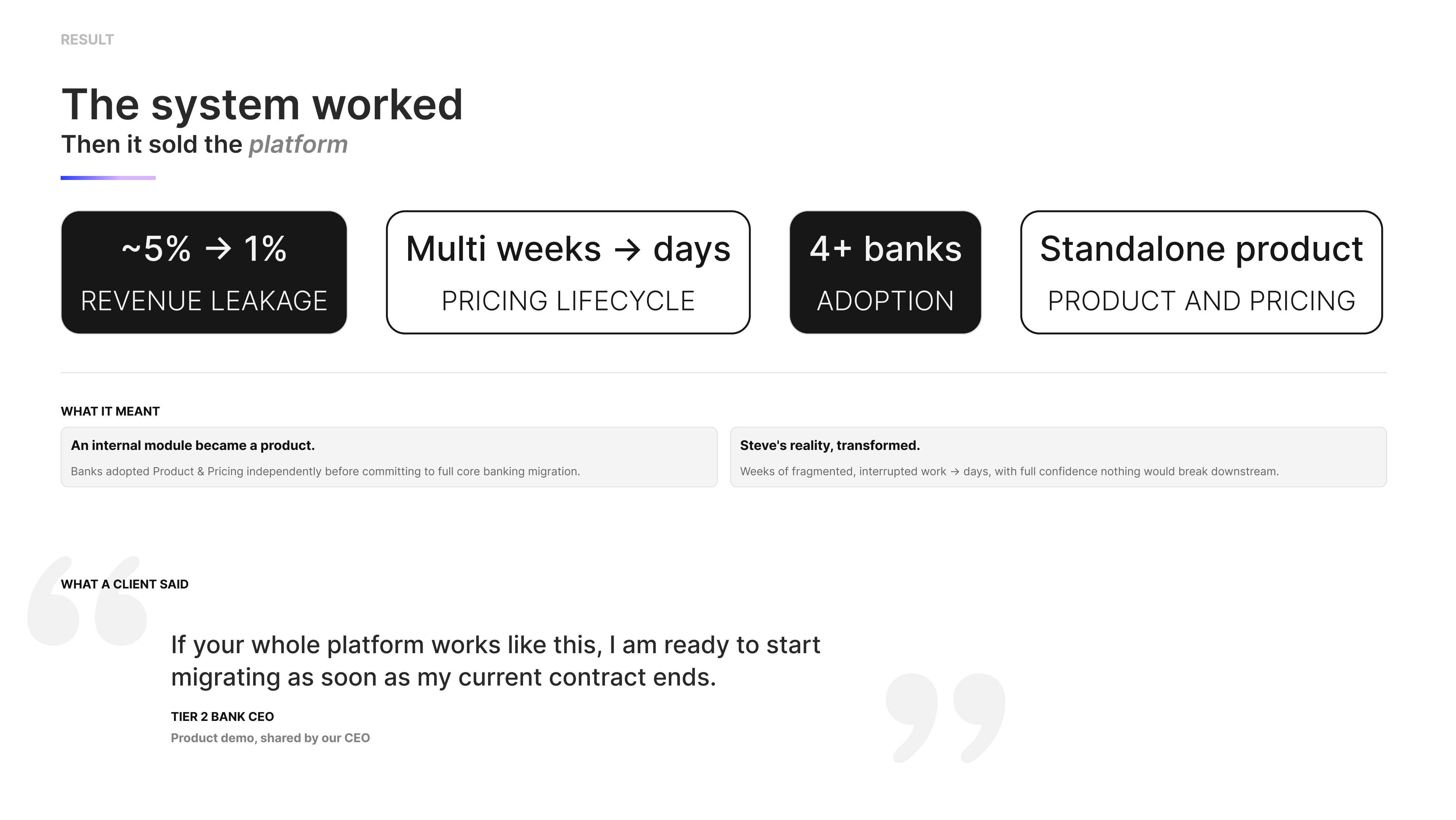
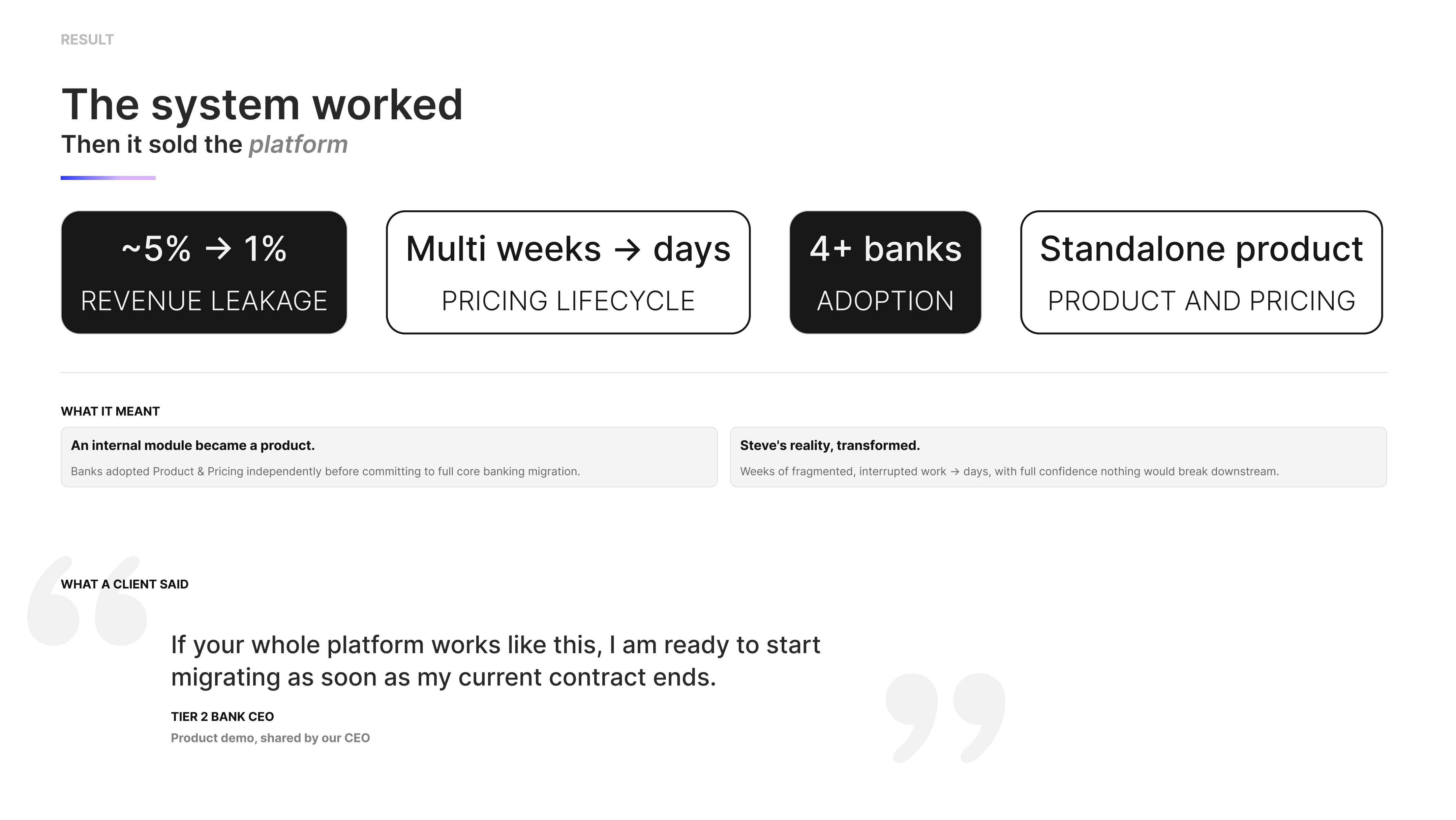
The Product & Pricing module evolved from an internal capability into a standalone enterprise offering — adopted independently by banking clients as a lower-friction entry point into broader SaaS core banking transformation.
The Impact
I led the end-to-end redesign of a governance-driven Product & Pricing platform for enterprise banking clients — centralizing product configuration, pricing orchestration, lifecycle management, and operational approvals into a unified SaaS-based ecosystem.
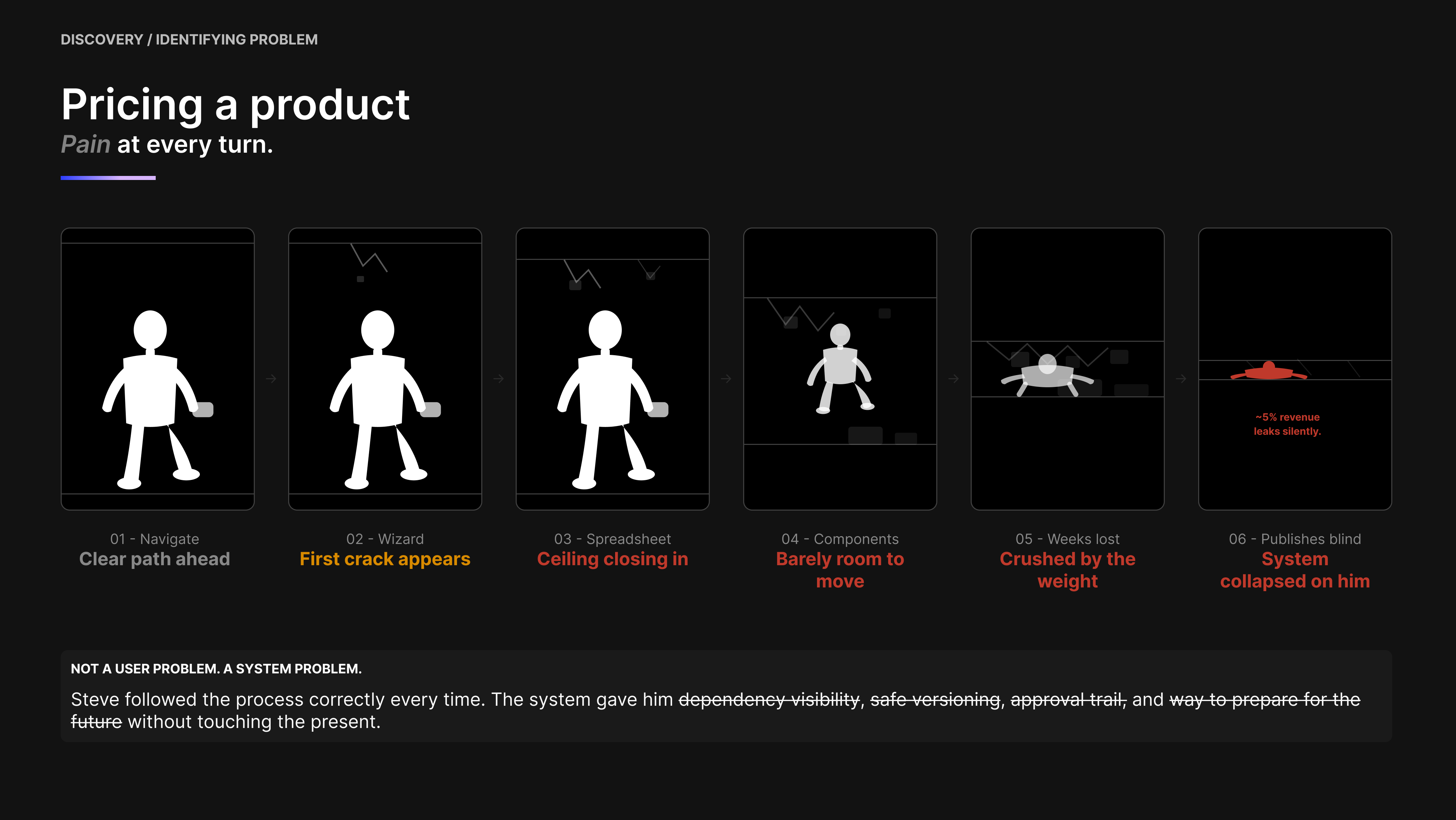
The core challenge was transforming fragmented pricing operations — spread across spreadsheets, legacy systems, and disconnected approval channels — into a scalable, governance-aware platform without disrupting the deeply embedded workflows of institutional banking users.
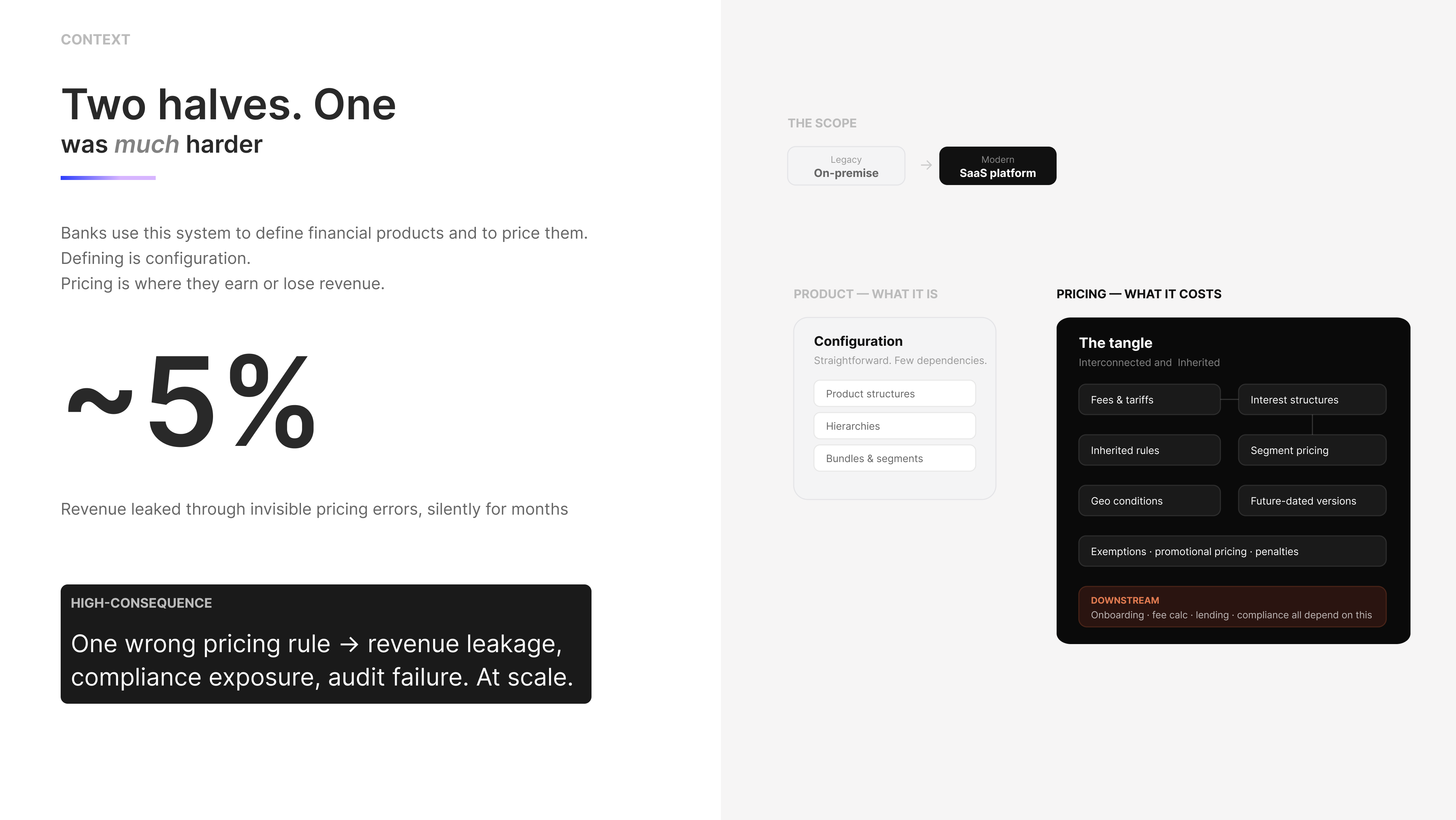
A single pricing configuration failure could trigger revenue leakage, compliance exposure, audit failures, or downstream operational breakdowns across the entire banking product portfolio.


The Product & Pricing module operated as a core revenue-configuration system within an enterprise banking platform, enabling pricing and product managers to define, govern, and launch financial products across multiple geographies.
The complexity was driven less by interface volume and more by:
- Invisible rule interdependencies
- Nested configuration logic
- Fragmented orchestration across modules
- Entitlement-driven access behavior
- Inherited pricing conditions
- Unpredictable downstream impacts from configuration changes
Users operated on deeply institutionalized mental models shaped by years of banking workflows, keyboard-heavy interaction patterns, and compliance procedures. Radical redesigns would have reduced trust and increased operational risk.
My design strategy focused on evolving the existing mental model incrementally — improving configuration clarity, dependency visibility, and workflow predictability without disrupting the execution rhythms of high-risk enterprise users.
System design
I owned the interaction strategy, workflow architecture, dependency handling patterns, error prevention mechanisms, and system-level navigation logic across the full product lifecycle. Both product and engineering teams depended on my UX strategy to formalize how pricing logic, interdependencies, and governance behavior would be operationalized within the platform.
Operational Ecosystem
The architecture involved deeply interconnected entities — product hierarchies, pricing structures, customer segment rules, geographic conditions, bundled offerings, lifecycle states, approval workflows, exemptions, and inherited pricing logic. Changes in one configuration layer could silently affect multiple downstream conditions.
Different banking institutions also operated with different governance models — maker-checker workflows, 2-eye/4-eye/6-eye validations, institution-specific pricing controls, and regional operational constraints. The platform needed to be both stable and adaptable across all of these.
Balancing modernisation with behavioral continuity was the biggest UX challenge
The Real Problem
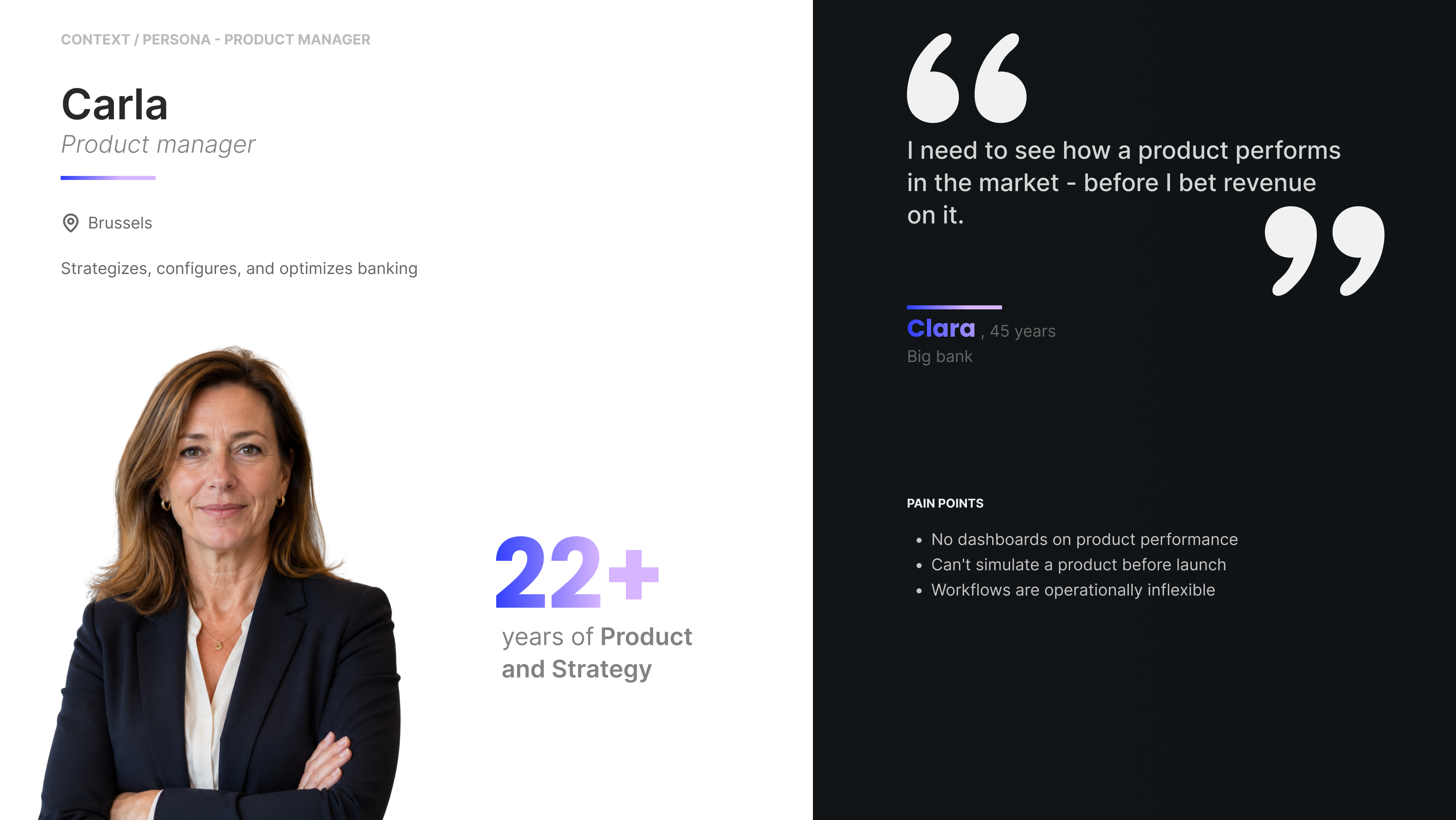
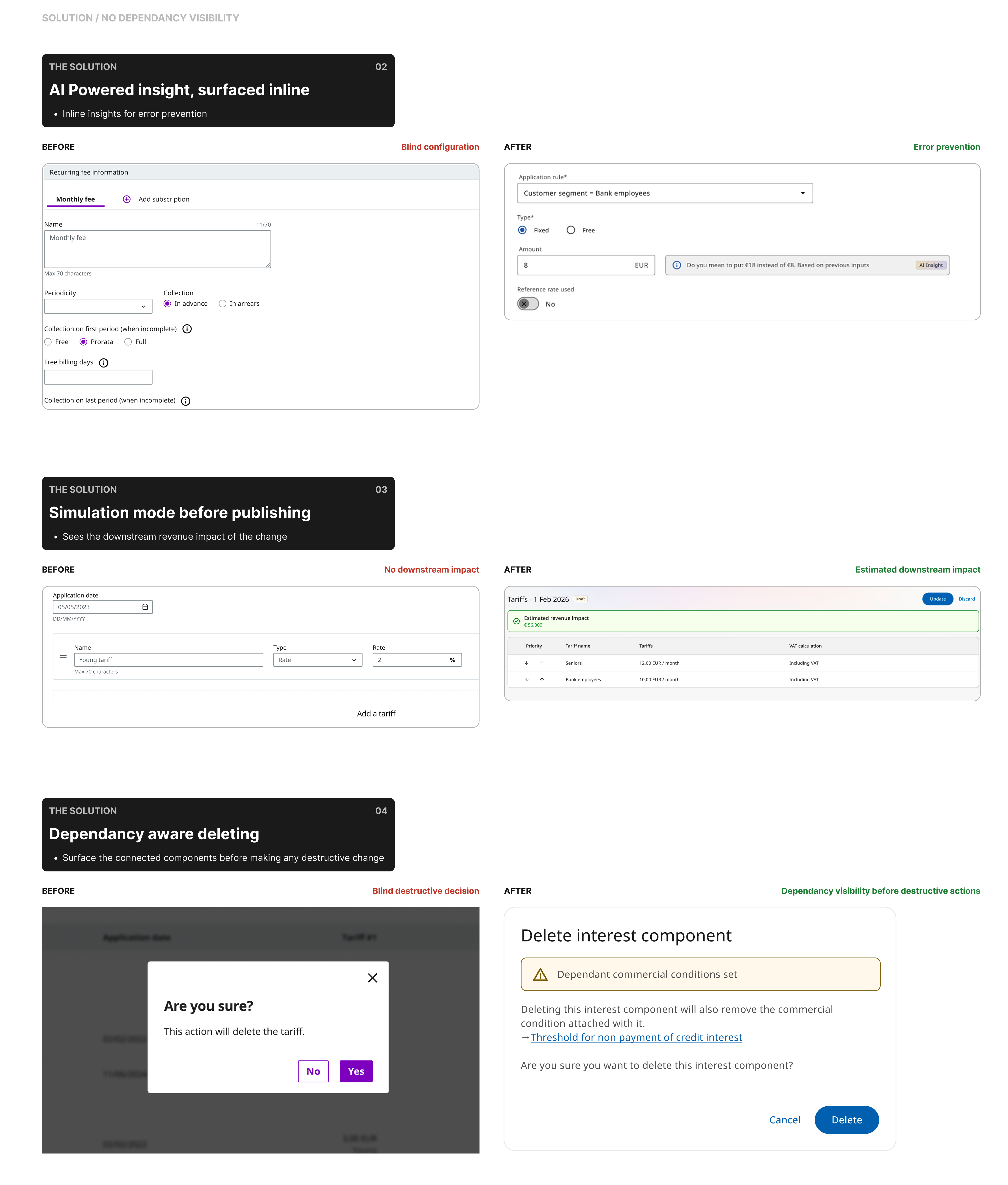
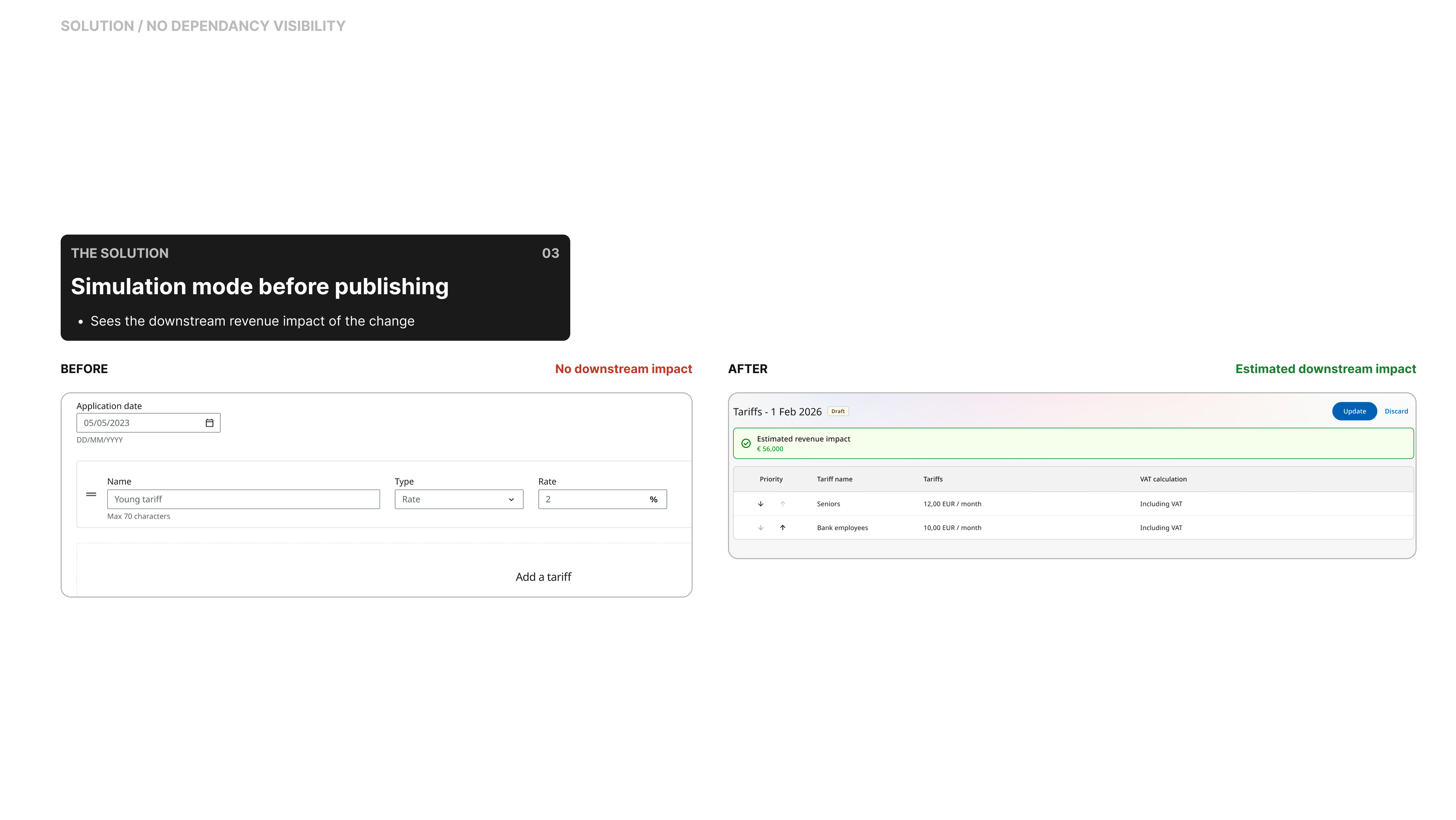
The real issue was the inability to predict operational impact before pricing changes reached production. I designed a simulation mode before actually pricing the product.
Workflow fragmentation

Product was handled somewhere else, pricing somewhere else and publishing somewhere else.
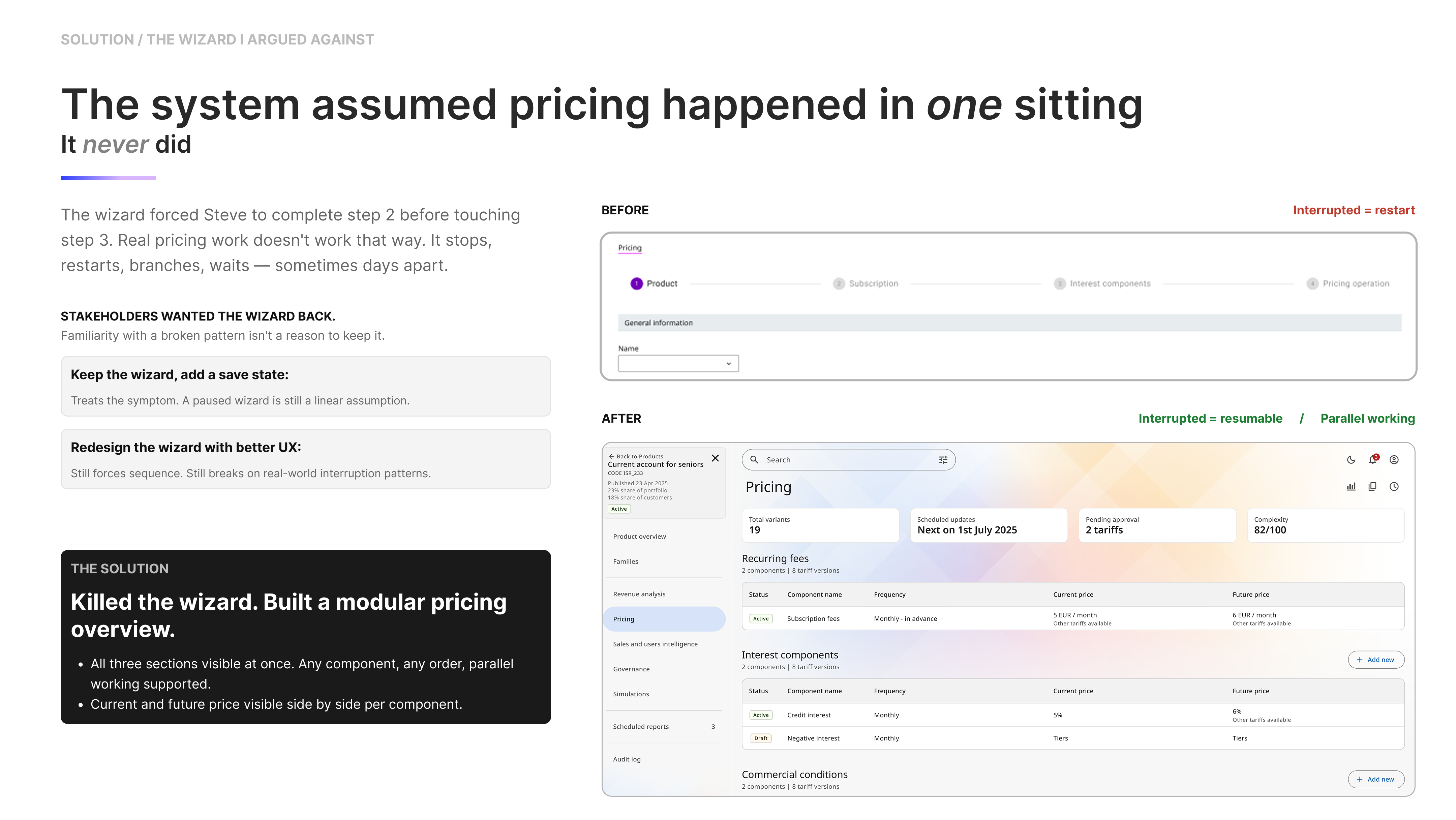
I brought this under one menu item using contextual menu
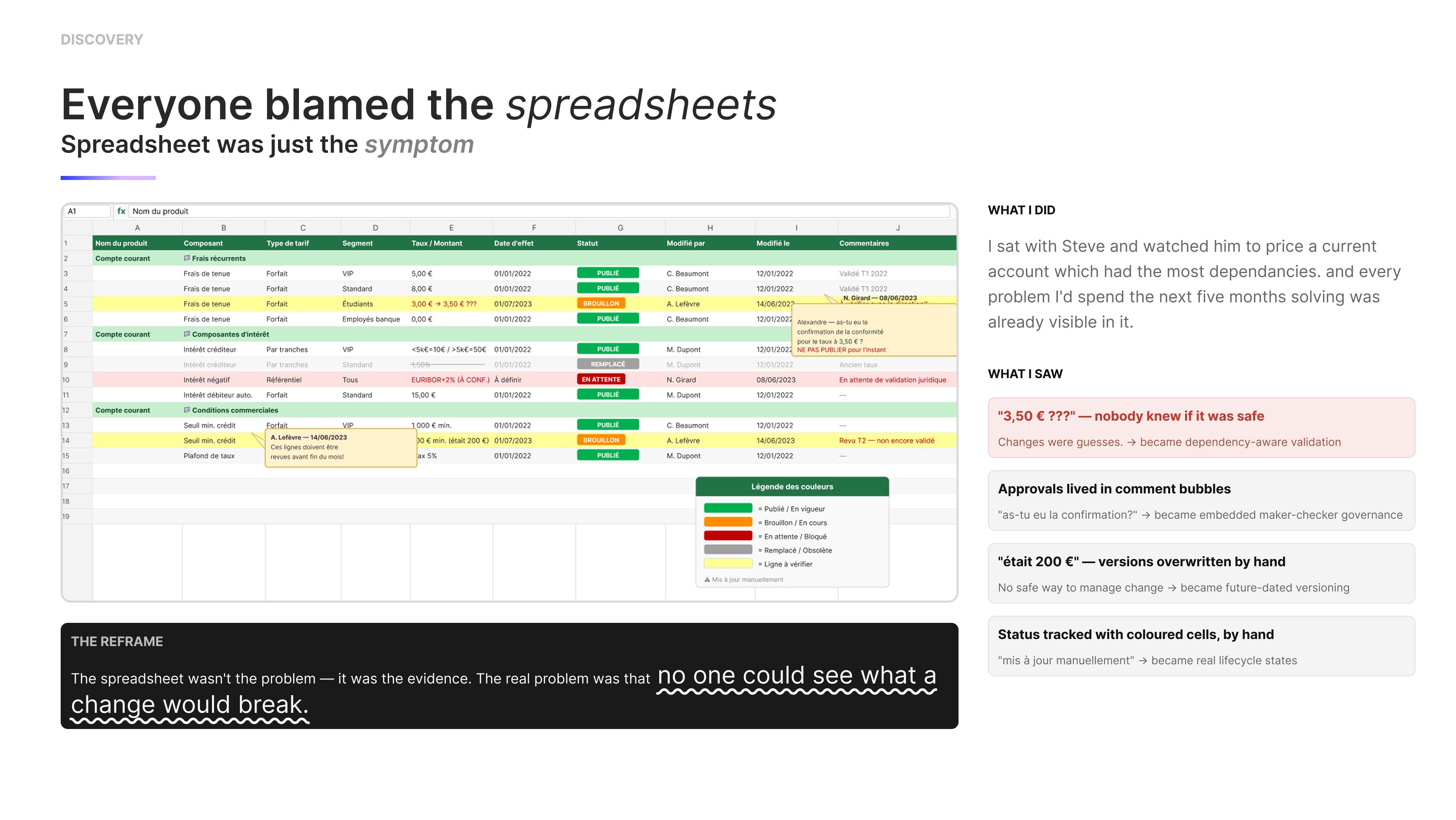
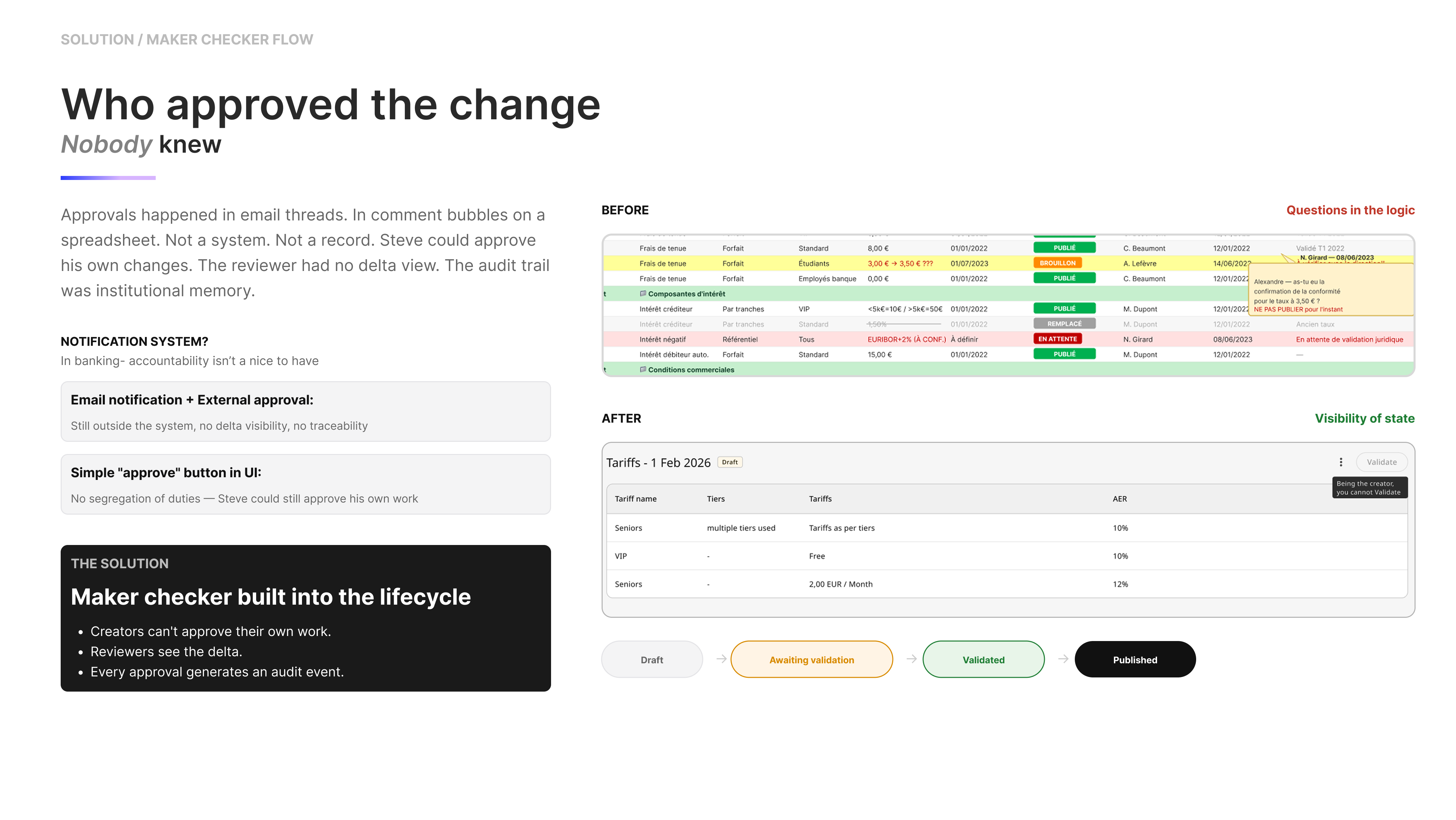
Overreliant on emails & spreadsheets

This led to reduced traceability, slowing decisions and weakening accountability.
TASK engine helped with notifications and keeping track of pending actions
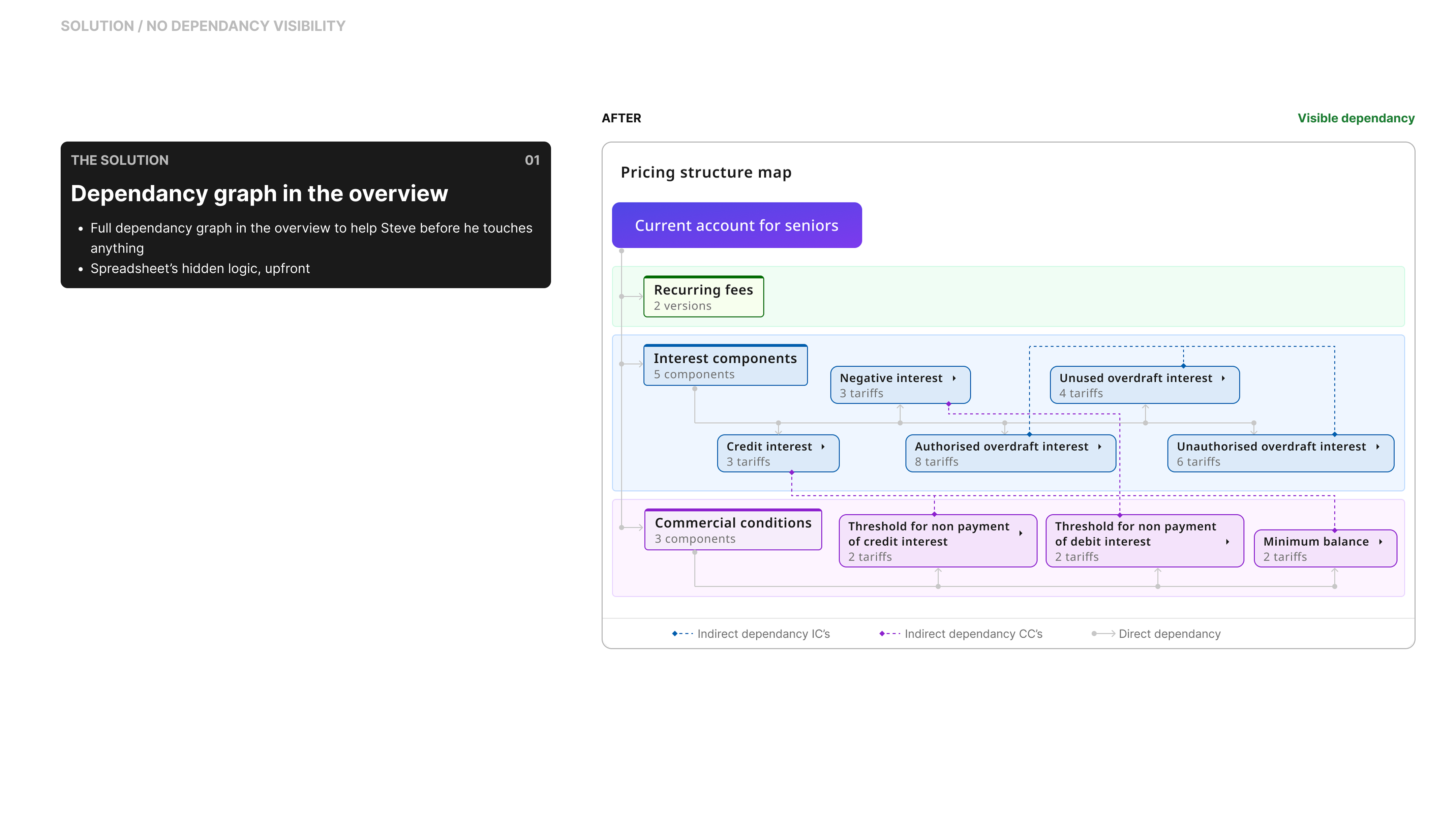
Absence of reliable dependency awareness

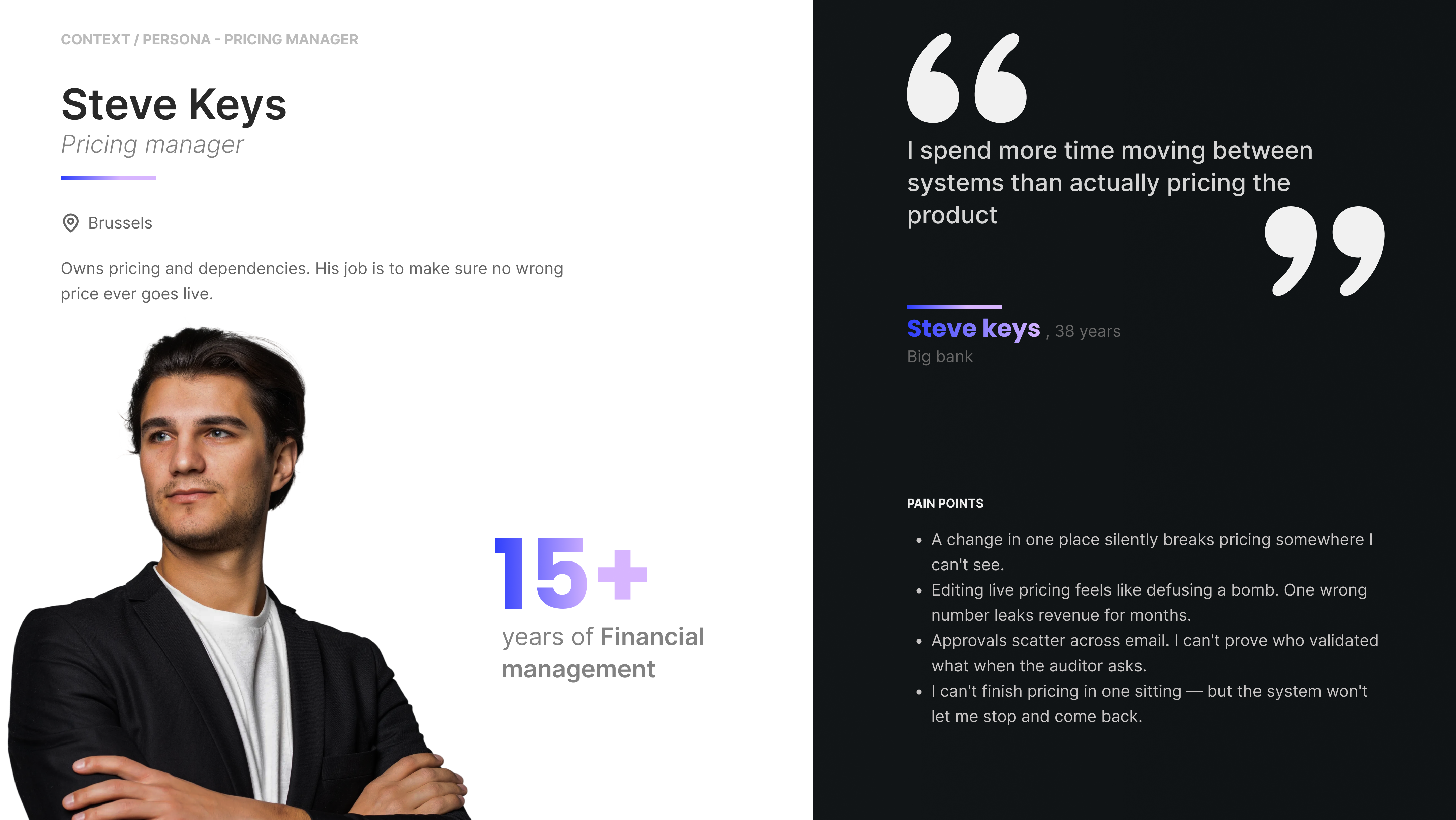
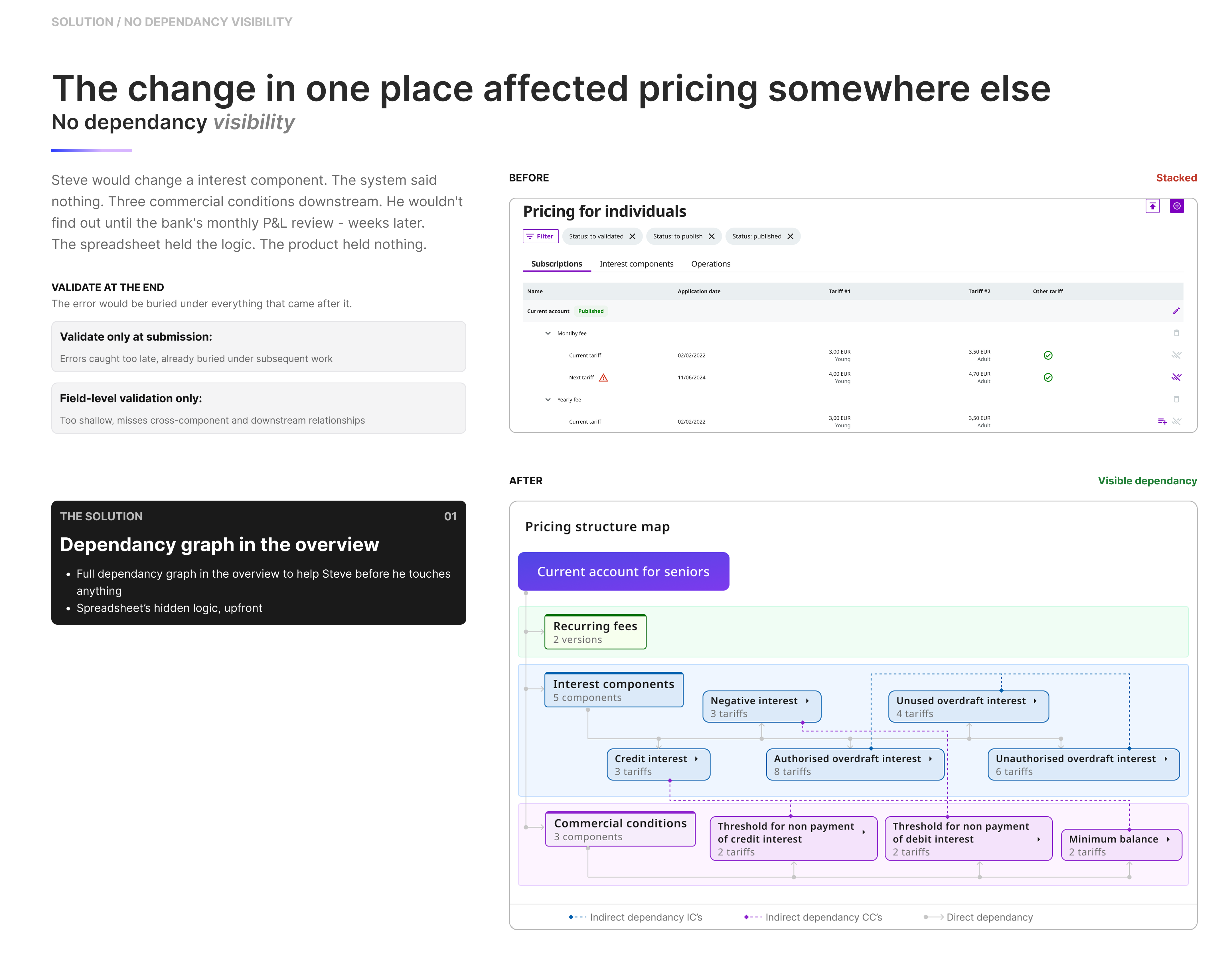
Changes in one configuration could silently affect downstream pricing conditions and operational outcomes.
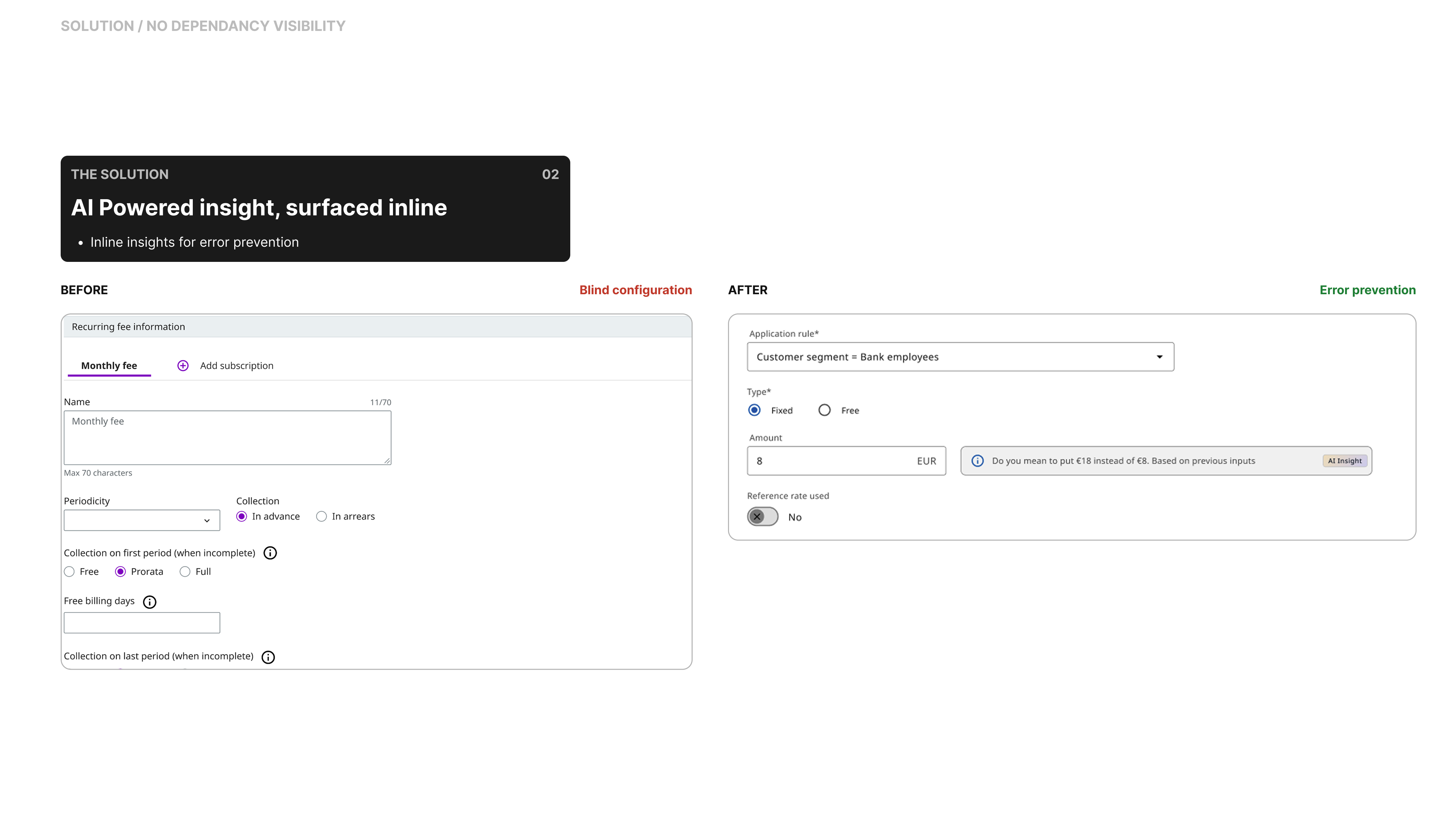
Dependency graph embedded in the overview and contextual error prevention while updating or creating new pricing
Pricing managers could not confidently predict how one change would impact downstream pricing conditions, lifecycle states, or future-dated versions.
Workflow Reality
Enterprise pricing workflows are not linear. They are:
- Interrupted
- Collaborative
- Governance-driven
- Future-dated
- Dependent
- Impact-sensitive
Workflows evolved across multiple operational sessions, dependency reviews, governance checks, and stakeholder approvals. Coordination had historically been fragmented across spreadsheets, emails, messaging tools, and institutional memory.
Pricing behaviour depended heavily on operational continuity and muscle memory
Platform Evolution
We intentionally rejected wizard-based flows because operational workflows were too non-linear, interruption-prone, and approval-driven.
Final workflow architecture emphasized on -
Task-based progression

Moves away from linear workflows - each task in the platform is self-contained.
Built TASK engine to support PPB and other components in banking suite
Lifecycle-driven orchestration

Ensures pricing, products and rules are updated as part of consistent lifecycle operations
Lifecycle supporting versioning, approvals and deployment across the bank
Incremental operation updates

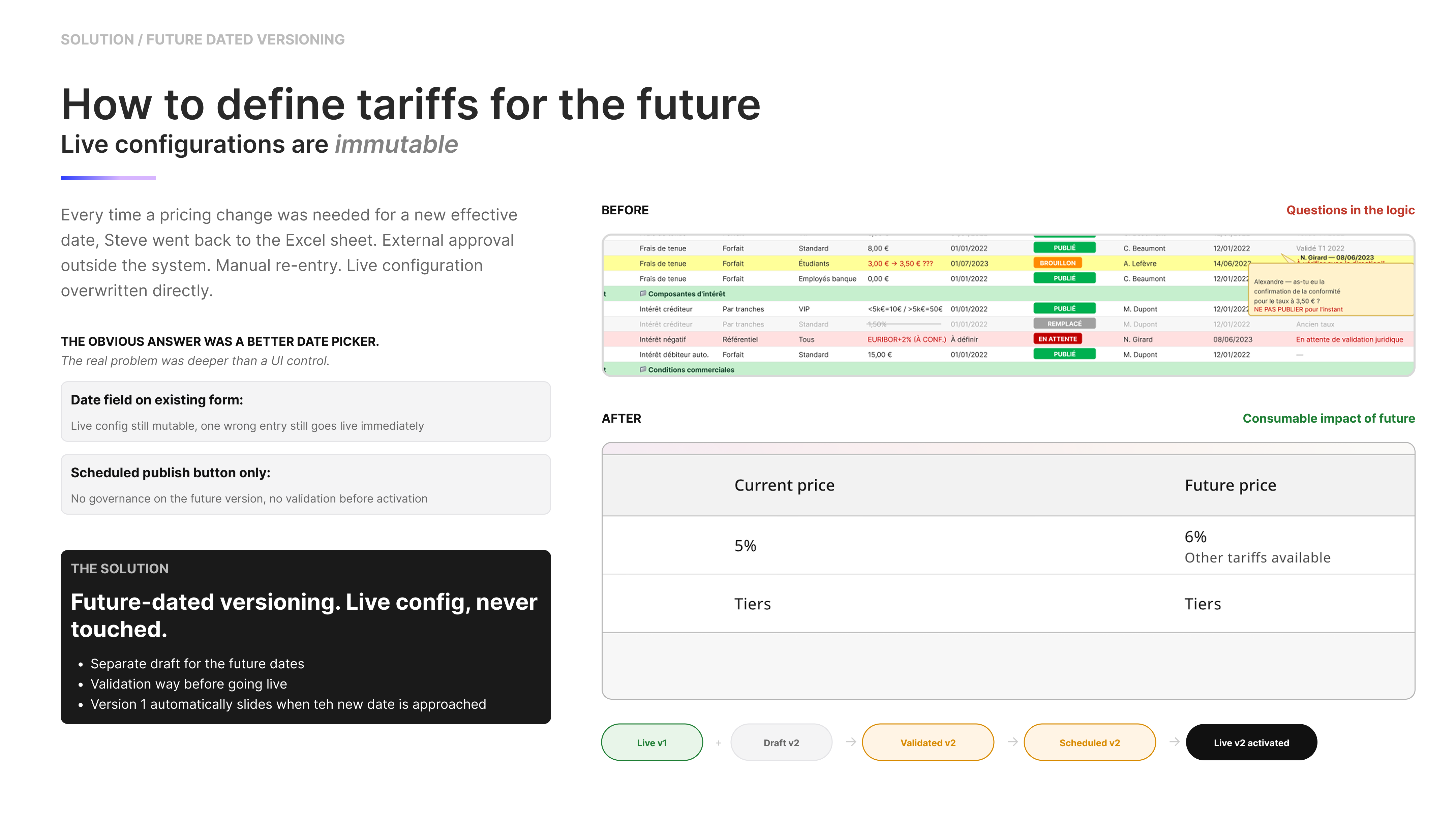
Pricing, product and rule changes are managed as incremental updates within an operation rather than full snapshots
Each change is considered an operation that needs an approval
Dependency visibility

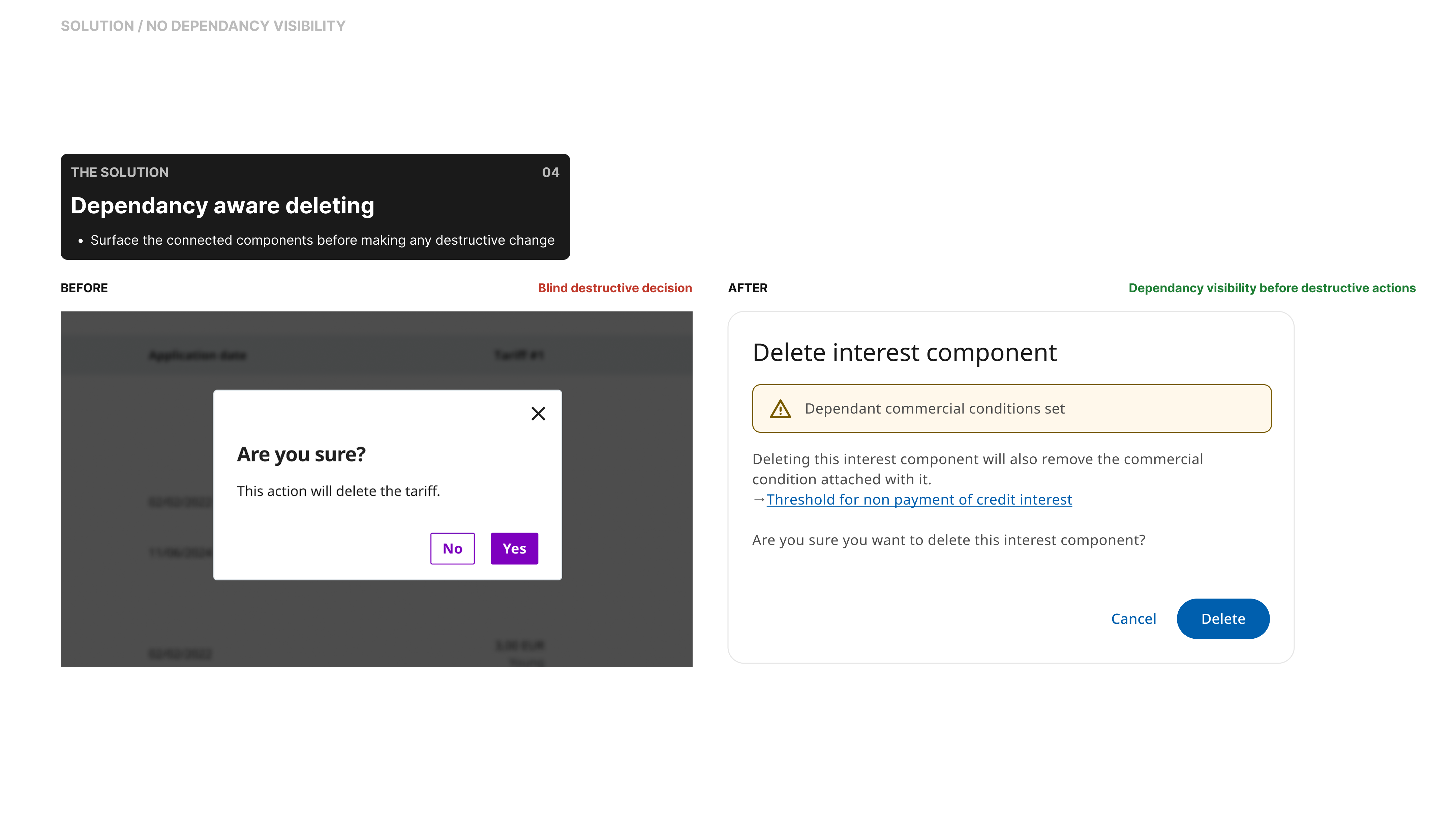
Makes all pricing-product, product-rule and rule-rule dependencies explicit and visible
Designed the system to be interconnected and auto-detects anomalies making error prevention easier.
Governance awareness

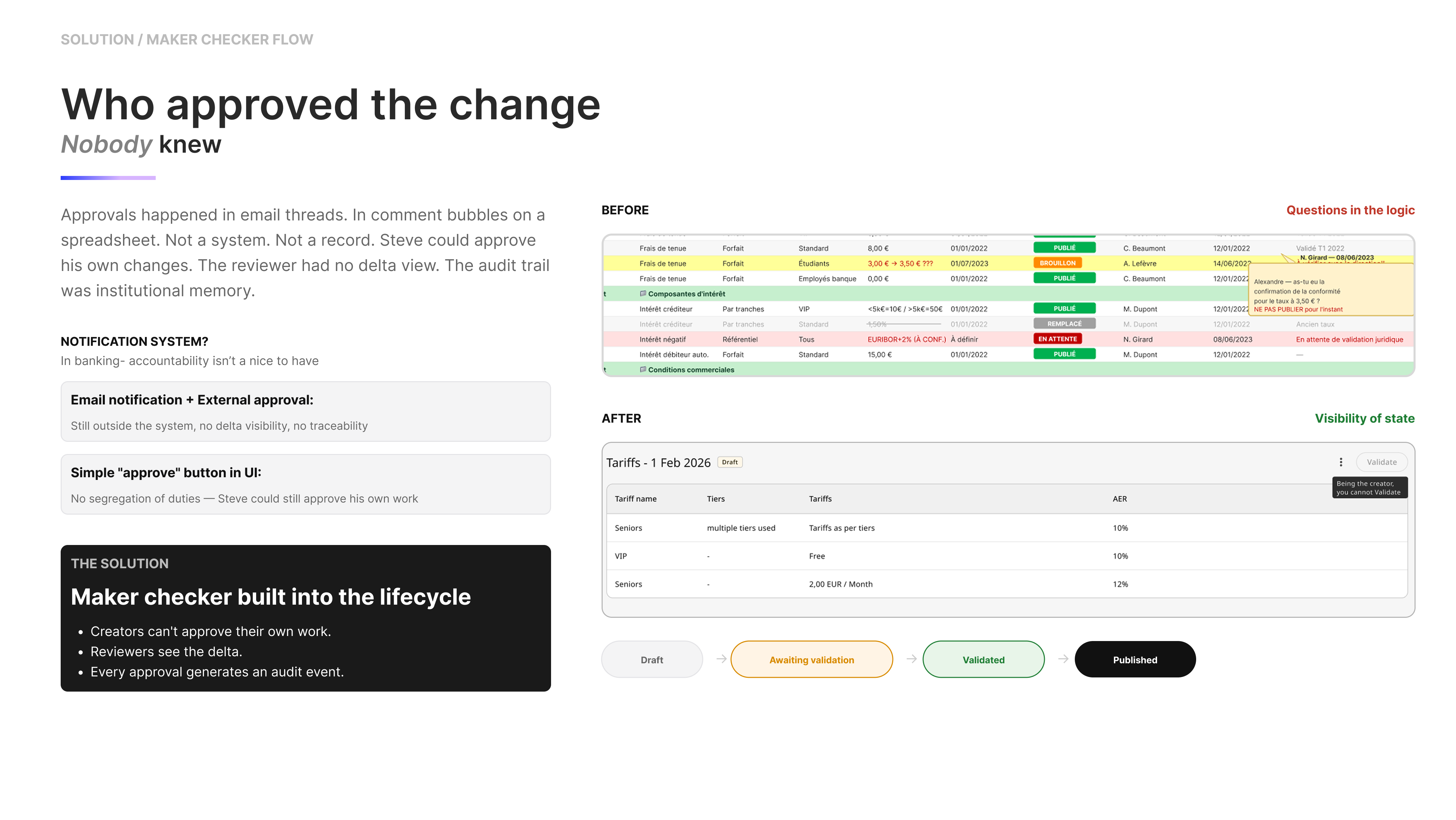
Institutional approval workflows, maker-checker controls, and bank-specific compliance mandates are embedded into operational flows.
In-field validations were in place to handle error prevention rather than error handling
Version safe operational transitions

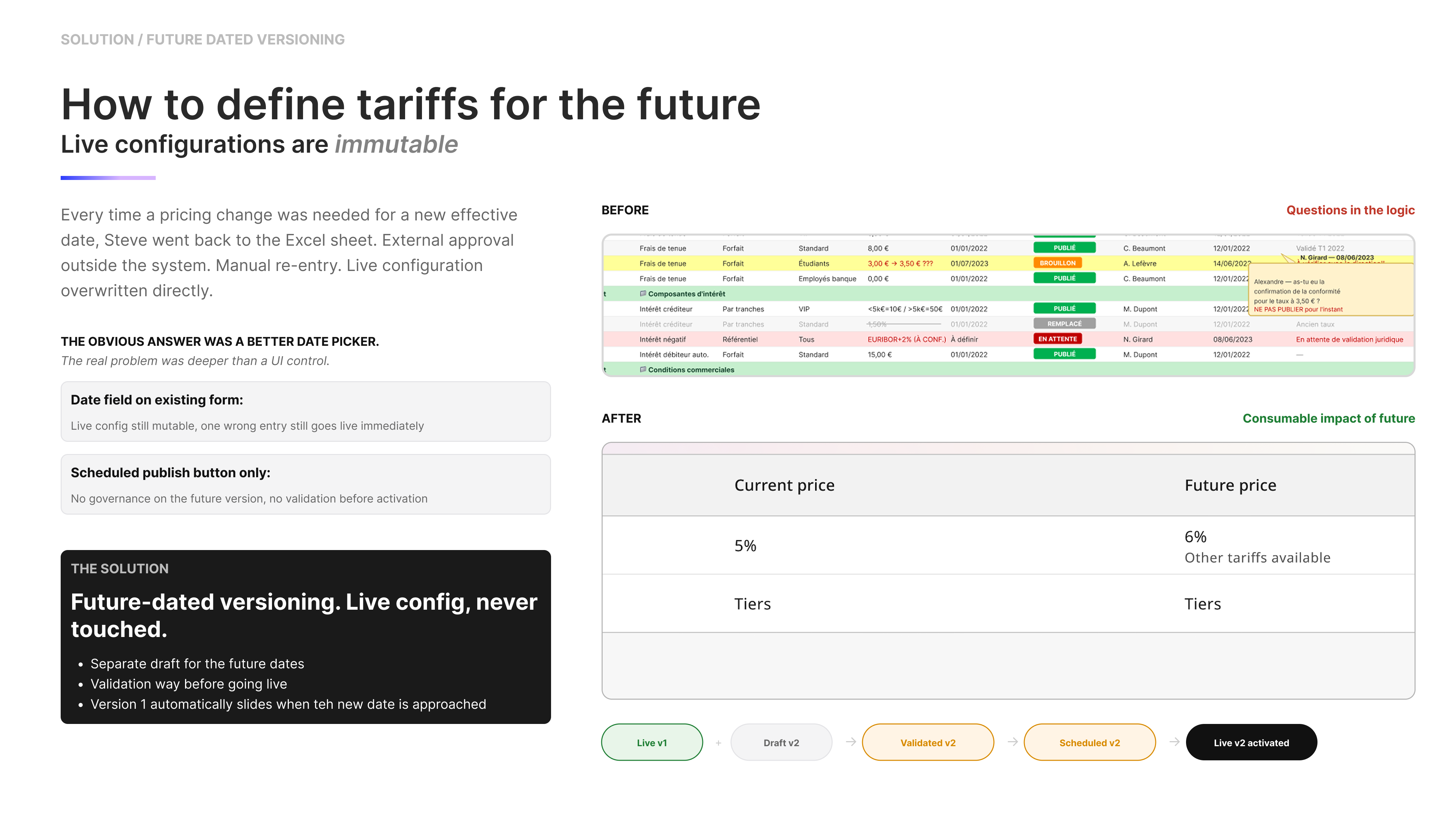
Rules, product configurations, and pricing conditions are versioned, future-dated, and published in controlled transitions.
Made the system as a supportive one by helping users at every important step.
Design Strategy
Rather than optimizing for visual simplification alone, I prioritized:
Error prevention over recovery

Invalid operational states were prevented before publication.
In-field validations were in place to handle error prevention rather than error handling
Operational trust over visual simplicity

Visibility and predictability mattered more than minimal UI.
Calculated predictability of users changes and warned if there was any impact on downstream conditions
Keyboard-first efficiency

Enterprise users operated primarily through muscle memory.
System is keyboard-first while allowing a global accessibility mode for all specially-abled users
Dependency transparency over hidden automation

Progressively disclose the complexity but remain transparent throughout the workflow
Built dependency graph to allow users understand impact of their changes before publishing
Enterprise pricing failures rarely emerged from isolated interface mistakes. Most failures came from invisible interdependencies between pricing entities, inherited rules, lifecycle states, and governance conditions.
I focused heavily on dependency visibility and contextual operational awareness. For example, if a pricing manager attempted to remove a pricing component that still had dependent commercial conditions attached, the system surfaced those dependencies contextually — before the change could be finalized — and guided users toward resolution paths. This dependency-aware interaction model extended across pricing structures, tariff configurations, conditional business rules, lifecycle states, inherited product logic, future-dated versions, and approval workflows.

Validation was integrated progressively throughout the workflow rather than concentrated only at submission.
Workflow Segmentation
To reduce cognitive overload, I introduced structured workflow segmentation aligned to existing operational mental models — separating product configuration, pricing structures, interest components, recurring fees, commercial conditions, validations, and publishing workflows into logically staged layers.
Progressive Disclosure
Complexity was progressively disclosed based on contextual relevance.

Accountability & Integrity
I also redesigned the governance architecture to strengthen accountability and approval integrity. Maker-checker workflows were embedded directly into lifecycle orchestration. Users responsible for creating or modifying pricing structures could not approve their own changes. Reviewers had full visibility into pricing deltas, historical vs updated configurations, and audit context.
Key Decisions & Tradeoffs
A fully disruptive redesign would have reduced efficiency, slowed adoption, and weakened execution confidence. I modernized the system architecture, dependency visibility, governance flows, and lifecycle management while intentionally preserving keyboard-first interaction patterns, operational sequencing habits, and familiar execution rhythms.
System & Intelligence Layer
I designed the platform around a governance-driven lifecycle architecture that treated products, pricing structures, tariffs, validations, approvals, and publishing states as controlled operational entities — not isolated interface actions.
Platform Evolution
Products and pricing entities moved through clearly defined operational states: Draft → Awaiting Validation → Validated → Published → Invalidated → Draft.
The governance model enforced segregation of responsibilities:
Platform Evolution
Validation behavior evolved from passive error detection into proactive operational guidance. The system prevented invalid states rather than recovering from them.
Execution
This was not a project where I received a brief and delivered screens. I owned the UX direction end-to-end — from stakeholder alignment and system-level decisions to engineering handoffs and tradeoff negotiations.
How I led this
I led this project from the UX standpoint, but my role extended far beyond design. I was the person in the room connecting product strategy to engineering feasibility, translating business constraints into interaction models, and pushing back when shortcuts threatened operational reliability.
Stakeholder management across the organisation
Coordinated with product managers, engineering leads, banking domain experts, and compliance teams across multiple geographies to align on a unified platform direction.
Ran workshops, alignment sessions, and review cycles to ensure every team had visibility into design decisions and their downstream impact.
System design through flow diagrams
Created detailed flow diagrams that mapped operational workflows, state transitions, and governance checkpoints — not just UI flows.
These diagrams became the shared language between product, engineering, and compliance — reducing ambiguity in complex handoffs.
POC-driven advocacy
Adopted a proof-of-concept approach for every major design direction. Instead of static presentations, I built interactive prototypes that demonstrated real workflows.
This approach accelerated stakeholder buy-in and eliminated weeks of back-and-forth on abstract requirements.
Parallel UX initiatives that fed back into PPB
Led other UX initiatives in parallel — contextual menu systems, the TASK engine, and AI assistant workflows — that directly strengthened the Product & Pricing platform.
These were not separate projects. They were strategic bets I initiated to solve systemic problems across the banking suite.
Design advocacy in cross-functional meetings
Acted as the design advocate in engineering and product meetings — defending user-centric decisions, challenging assumptions, and ensuring UX quality was never traded for speed.
Brought all teams — engineering, product, and domain experts — to a shared understanding before any major decision was locked.
Tradeoff decisions with product
Worked directly with the product team on tradeoff decisions — where to simplify, where to expose complexity, and where to defer features to future releases.
Every tradeoff was documented with rationale so the team could revisit decisions as the platform matured.
Enterprise UX leadership is not about simplifying complexity away. It is about making complexity operationally survivable — and doing that requires influence, not just craft.
Reflection
Platform Evolution
The real value of this project was not the screens I shipped. It was the institutional confidence I helped rebuild in how pricing operations worked.
Leading this project changed how I think about design leadership in enterprise contexts. I walked in as a designer focused on interaction quality. I walked out understanding that the most impactful design decisions happen before a single pixel is placed — in stakeholder rooms, in tradeoff conversations, and in the system-level thinking that shapes what users never have to worry about.
What I took away
Influence matters more than output
The best design work I did on this project was not a screen — it was convincing engineering and product to invest in dependency visibility before it became a production failure.
Workflow continuity beats interface novelty
Banking users had decades of muscle memory. Redesigning their tools without respecting their operational rhythms would have caused more harm than good. I learned to balance modernisation with behavioral continuity.
Preventing failure is harder to sell than building features
Error prevention, validation intelligence, and governance safeguards are invisible when they work. Making stakeholders value what users never see was one of the hardest advocacy challenges.
Parallel initiatives compound impact
The TASK engine, contextual menus, and AI assistant workflows were not side projects — they were force multipliers. Running them in parallel let me solve systemic problems that no single project brief would have surfaced.
Enterprise UX creates the most strategic value when it improves how organisations operate — not just how interfaces look. Leading this taught me that design leadership at scale is about shaping decisions, not just deliverables.